Women Covering Conflicts
Women journalists had worked hard and long for the right to cover conflicts. Only one woman was accredited by the US military to serve as a war correspondent during World War I, and she was sent to Siberia. [1] In World War II, 127 women received accreditation, reporting for organizations as different as the New York Times and Women’s Home Companion. But only a handful of them reported from the front lines. [2] Buoyed by feminism and the civil rights movement, the number of female war correspondents rose to about 70 during the Vietnam War. But their access to soldiers and the battle front was often restricted on one pretext or another: there were no women’s bathroom facilities, their presence would distract (or perhaps arouse) the soldiers, the physical challenge of battlefield reporting was too great, protecting female journalists would put an undue burden on commanding officers, and so forth. [3]
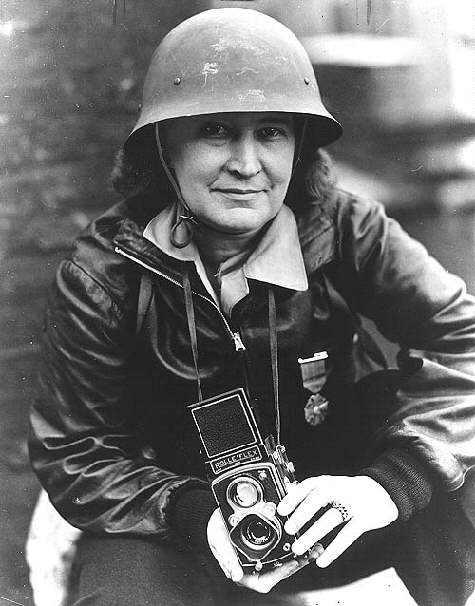
Woman journalist in World War II
By the 1990s and the conflicts in the Balkans, Iraq and Afghanistan, that had changed. Most news organizations gave female journalists the opportunity to cover conflict, asking them to decide for themselves what assignments they were willing to accept. Major media organizations offered war reporters hostile environment training, field security, peer support, medical attention, and psychological counseling when needed.
The nature of war had also changed. Correspondents saw fewer traditional battles and more guerilla attacks, tribal and ethnic clashes, civil wars and protests, suicide bombings, drug wars, and terrorist operations. The dangers to conflict reporters—both men and women—multiplied. Correspondents were caught in crossfire, abducted, murdered or attacked by mobs. The death toll rose. In December 2010, the Committee to Protect Journalists (CPJ) reported that over the preceding 19 years, 847 journalists had been killed, more than a third of them in war zones or covering human rights stories. [4]
Silencing crime . In this new climate of equal access to assignments, women reporters struggled to deal with a different challenge: sexual aggression. There had always been complaints of sexual harassment in the newsroom and on the street. But now journalists covering conflicts—the vast majority of them women—also experienced uninvited sexual advances from sources and fixers, casual groping by strangers, sexual threats from targets of investigations, and deliberate sexual assaults intended as reprisal or intimidation. Sexual assault was dubbed “the silencing crime” for two reasons: its intent was often to quash a story or punish a journalist, and few journalists were willing to talk about it. As one researcher reported:
Journalists from all over the world said they largely kept assaults to themselves because of broad cultural stigmas and a lack of faith that authorities would act upon their complaints. But time and again, journalists also said that professional considerations played an important role; many were reluctant to disclose an assault to their editors for fear they would be perceived as vulnerable and be denied future assignments. [5]
Between the challenges of conflict reporting and the threat of sexual aggression, female journalists were learning to walk a fine line.
[1] Mark Jenkins, “Gal Reporters,” National Geographic News, December 10, 2003. See: http://news.nationalgeographic.com/news/2003/12/1210_031210_warwomen.html
[2] Library of Congress, “War, Women, and Opportunity,” description of a Library of Congress exhibit titled “Women Come to the Front: Journalists, Photographers, and Broadcasters During World War II,” 1995. See: http://www.loc.gov/exhibits/wcf/wcf0002.html
[3] Joyce Hoffmann, “On Their Own: Female Correspondents in Vietnam,” Old Dominion University’s Quest, Vol. 2, No. 1, Fall 1998, pp.2-5. See: http://www.odu.edu/ao/instadv/quest/FemaleCorrespondents.html
[4] Committee to Protect Journalists, “896 Journalists Killed Since 1992.” See: http://cpj.org/killed/2011/ .
[5] Lauren Wolfe, “The Silencing Crime: Sexual Violence and Journalists,” Special Report of the Committee to Protect Journalists , June 7, 2011. The report was based on interviews with 50 journalists who had been sexually assaulted. See: http://cpj.org/reports/CPJ.Sexual.Assault.Journalists.pdf