Path to Photojournalism
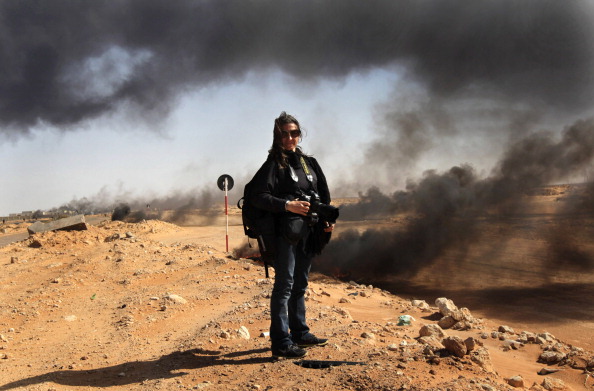
Lynsey Addario
©
Getty Images
Addario came to photojournalism via international relations, which she studied as an undergraduate at the University of Wisconsin (Madison) with the idea of helping people understand humanitarian crises. Turned down for graduate study by the Columbia Journalism School in 1996, Addario took her manual Nikon camera to Argentina. There she landed a job with the Buenos Aires Herald by sneaking onto the set of the film Evita and snagging a photograph of its blockbuster star, Madonna. Back in the US a year later, she put in three years as a stringer for the Associated Press, making a name for herself in Cuba, where American business, tourism, and diplomatic activities were strictly limited.
Her photos attracted notice and she developed long-term relationships with several media outlets: Time, Newsweek , National Geographic , the New York Times and the New York Times Magazine . She worked alone or on short-term projects with writers and videographers. She found her work satisfying. “I am…doing exactly the type of photojournalism I set out to do—covering humanitarian and women’s issues, and the toll conflicts take on civilians and soldiers alike,” she told American Photo magazine at the beginning of 2010. [6]
In 2000, Addario went to Afghanistan to document the lives of women under Taliban rule. She went by herself and paid her own way. After the terrorist attacks of September 2001, as the United States took up arms in Afghanistan, she found herself drawn into conflict reporting, first in Afghanistan and Pakistan, then in Iraq, and later in Lebanon, Darfur, and the Democratic Republic of Congo. By 2010, she had covered American women in combat, drought in the Horn of Africa, transsexual prostitutes in New York, opium addiction among Afghan women, genocide in Darfur, maternal death in Sierra Leone, and rape as an instrument of war in Congo. She lived variously in Istanbul, Mexico and Delhi. Her passport bore the stamps of more than 60 countries.
Advocate . Addario had become a strong advocate for female journalists working in conflict zones around the world. She bristled at suggestions that news organizations should limit women reporters’ assignments out of concern for their safety. “To me, that’s grossly offensive,” she believed. “This is my life and I make my own decisions. If a woman wants to be a war photographer, she should [be].” [7] She argued that female journalists had privileged access to some people, places, and stories that male journalists could never hope to cover, not only in the Middle East but throughout Africa and South Asia. Many of her best-known pictures were taken in closed-door places: in private homes and domestic quarters, in the maternity ward, at a secret wedding, in a mental health hospital, at a prayer service in the women’s section of a mosque, in prisons, and in domestic violence shelters. She noted:
But Addario was also a realist. She knew that the demands of conflict photography could be daunting for women, especially for small women (Addario stood 5 feet, 1 inch) and for those working solo. The equipment was often heavy and cumbersome to carry; conditions on the ground were unpredictable, sometimes dangerous. Over the years she had developed a set of rules and regimens to keep her safe and competitive with her male colleagues. She kept fit, running daily and hitting the gym whenever she could. She traveled light. She wore a flak jacket and helmet in combat situations, and she carried her BlackBerry™ everywhere she went.
Women offer a different perspective. We have access to women on a different level than men have, just as male photographers have a different relationship with the men they’re covering. [8 ]
[6] Amy Bedick, “Photography on the Front Line,” American Photo, February 3, 2010. See: http://www.popphoto.com/how-to/2010/02/photography-front-line
[7] Lynsey Addario, “It’s What I Do,” New York Times Lens Blog, March 30, 2011. See: http://lens.blogs.nytimes.com/2011/03/30/lynsey-addario-its-what-i-do/
[8] Ibid.