Into Libya
Arab Spring came to Libya in mid-February. It began with demonstrations in the east, far from the capital, Tripoli. By February 20, insurgents had taken control of the country’s second-largest city, Benghazi. Qaddafi vowed to crush the insurgency, purifying Libya “inch by inch.” [24] In a rambling speech on February 22, Qaddafi called the protesters “greasy rats,” alleging that they were Islamist militants, al Qaeda operatives, criminals, and misguided youth under the influence of hallucinogenic drugs.
The Times , which had sent Addario to cover a pro-democracy demonstration in Bahrain, asked her to go next to Libya. She had been to Libya before, in 2004, to shoot portraits of Qaddafi and his son Seif al-Islam el-Qaddafi for Time magazine. This time, the circumstances were very different. Addario could enter Libya legally only as an invited journalist on a state-issued visa. But the Times already had accredited journalists in Tripoli reporting under the watchful eye of their Qaddafi minders; it needed reporters with the insurgency. Addario decided to cross the border from Egypt, in defiance of a Qaddafi arrest order issued on February 23 against foreign journalists without proper papers.
Addario debated whether to take her body armor. The situation was tense, but she wasn’t expecting much fighting. She had covered the fall of regimes before—the 2001 end of Taliban rule in Afghanistan and the 2003 collapse of Saddam Hussein in Iraq—and neither time did she see combat. Also, the armor might cause problems as she traveled through Egypt. Since the Tahrir Square uprisings, authorities had been confiscating flak jackets at customs, making journalists wait weeks for them to clear. Addario didn’t want to waste time or draw undue attention to herself. The flak jacket and helmet stayed behind. “I had that misconception that we would drive in and Qaddafi would fall and then we’d all rush in and it would be this jubilation,” she says. “I wasn’t mentally prepared for heavy combat.”
Addario crossed the Egyptian border on February 26 and made her way to Benghazi, capital of the insurgency. Libya’s Arab Spring seemed to be going according to script. Army officers were defecting to the opposition side in Benghazi; the insurgents were forming an interim government. [25] Addario’s first published photograph showed a group of young rebels straddling the cannon of a captured tank, waving the flag of the insurgency and flashing victory signs . Another showed a wall of graffiti in an outdoor plaza; among the Arabic inscriptions was one scrawled in English: “Game O ver .”
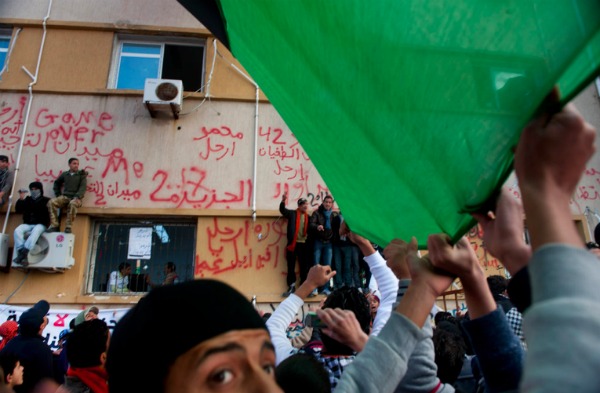
Libyan protesters in front of "Game Over" graffiti
Photo by Lynsey Addario
In Benghazi . Over the next four days, Addario reported from Benghazi alongside a growing number of foreign journalists who had also made their way across the Egyptian border. Among them was Tyler Hicks, a Pulitzer prizewinning staff photographer at the New York Times with extensive experience photographing conflicts and war zones in the Middle East, the Balkans, Russia, and Africa. Hicks and Addario had known each other for years (coincidentally, they attended the same high school in Westport, Connecticut). Together with Ed Ou and Scott Nelson, two other photographers freelancing for the Times in Benghazi, they took pictures of the usual scenes of protest and insurgency: opposition headquarters, weapons stockpiles, Friday prayers. They were waiting for Qaddafi to fall.
But by early March, it was clear that Qaddafi was not going to back down. Security forces were firing on demonstrators in Tripoli and Zawiya, and government troops were moving on Misrata with tanks. Scores were dead. In a speech on March 2, Qaddafi derided recent sanctions imposed by the US and the European Union, railed against foreign journalists, and vowed to fight “to the last man and woman.” As loyalist forces pushed farther east, fighting broke out in Brega, a port city 125 miles west of Benghazi. For the journalists in Libya, the front line was now within reach. It was an unusual opportunity. As Hicks put it:
Despite what a lot of people think, when you go to a war zone, there are a lot of formalities and difficulties to reach the fighting. You can get into a country but to get to where the conflict is happening can be very difficult. This is a very rare situation: complete access to a war, from the opposition side. [26]
Addario had to make her own calculus. Should she stay in Benghazi or go to the front? If she moved forward, the Times would pay her expenses, but could she find food and lodging? Would she be safe without her body armor? Hicks was going on ahead. Would he watch her back? Would traveling with the rebels put her in added danger? Would it compromise her reporting in any way? In any conflict, there were many stories. Which one did she want to tell? The Times, Al Jazeera , Reuters, and other news organizations, as well as citizen journalists using social media, were telling the Benghazi story. But few were reporting on the fighting—it was mostly rumors. Qaddafi had imposed a media blackout on military operations, and had warned off foreign news organizations.
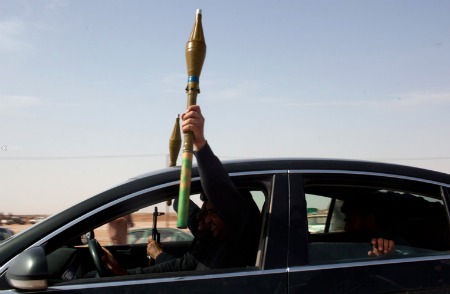
Rebels with mortars
Photo by Lynsey Addario
Addario made up her mind. “The journalist’s instinct is to want to go as far forward as possible,” Addario said in a March 2 interview. “When [a government is] attacking cities and civilians with machine-gun fire and air strikes, that’s an issue that needs to be addressed.” [27] That same day, Addario struck out for the front line. That evening, she filed her first picture from Brega. Taken in the hospital morgue, it showed an attendant covering the face of a rebel soldier killed by Qaddafi fire . Addario was no longer covering a protest movement. She was covering a civil war.
[24] “Muammar Gaddafi Speech Translated (2011 Feb 22),” YouTube, uploaded February 23, 2011. See: http://www.youtube.com/watch?v=69wBG6ULNzQ
[25] David D. Kirkpatrick, “In Libya Capital, Long Breadlines and Barricades,” New York Times, February 26, 2011. See: http://www.nytimes.com/2011/02/27/world/africa/27libya.html
[26] Kerry MacDonald and David Furst, interviewers, “In the Thick of Libya’s Brutal Fighting,” New York Times Lens Blog, March 9, 2011. See: http://lens.blogs.nytimes.com/2011/03/09/in-the-thick-of-libyas-brutal-fighting/
[27] Lynsey Addario, “At a Deadly, Shift Front in Libya,” New York Times Lens Blog, March 3, 2011. See: http://lens.blogs.nytimes.com/2011/03/03/at-a-deadly-shifting-front-in-libya/