News & Updates Archives

News & Updates | In The News

Home > News & Updates

WSJR Features MindUP Curriculum

The Sunday morning show The Wall Street Journal Report with Maria Bartiromo featured an interview with Goldie Hawn speaking about the MindUP curriculum.

MindUP is a PreK-8 social and emotional learning curriculum recently published by Scholastic, Inc. In the interview, Hawn discusses the initiative and its impact on children's learning and well-being.

CCNMTL is creating an online professional development companion to MindUP that will be used to train teachers to implement the program's curriculum in the classroom. This project is funded by The Hawn Foundation and will include contributions from faculty at Teachers College and Columbia University.

CCNMTL Featured in FutureGov Asia Pacific

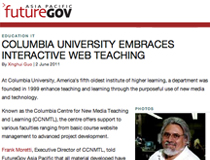
FutureGov thumbnail FutureGov Asia Pacific, a magazine for public sector organizations and leaders in Asia and the Middle East, recently highlighted CCNMTL in an article entitled Columbia University embraces interactive web teaching. The article features CCNMTL executive director Frank Moretti discussing the center's emphasis on working with faculty to develop web-based technologies specifically for their individual curriculum.

The article focuses on Video Interactions for Teaching and Learning, a web-based learning environment created by CCNMTL that enables students to view, analyze, and communicate ideas with video.

Malcolm X Multimedia Study Environment Revisited

The New York Times' article A Digital Critique of a Famous Autobiography discusses the multimedia study environment created by CCNMTL in 2005 for The Autobiography of Malcolm X based on research by Professor Manning Marable and his graduate students. The web site has gotten renewed attention after Professor Marable's book, “Malcolm X: A Life of Reinvention,” was published last month.

The article, written by Noam Cohen, points out the vast number of multimedia references in the study environment, the accessibility of the text for study using paragraph numbering and search, the restricted access due to copyright limitations, and the unfortunate deterioration of the web site as technology standards march on leaving old sites looking distressed.

The "Autobiography of Malcolm X" multimedia study environment is still in use at Columbia. Columbia instructors wishing to use it should contact CCNMTL to obtain access.

HuffPost Interviews Goldie Hawn on MindUP

The HuffPost Living blog released an interview of Goldie Hawn by Marianne Schall, where Ms. Hawn discusses the MindUP program. During the interview, she briefly discusses scaling the MindUP program by creating an online version with help from Columbia (CCNMTL). For more details on this project, see our project portfolio entry for MindUP.

Public Health Publication Features Columbia Global Course

The Friday Letter, a weekly publication of the Association of Schools of Public Health, released an article entitled, Expanding the Knowledge Network through Columbia’s Global Classroom, highlighting how students from Indonesia and Sri Lanka are tuning in to classes at Mailman School of Public Health.

The April 15, 2011 article focused on the course, “Protection of Children in Disaster and War,” taught by Dr. Neil Boothby, the Allan Rosenfield Professor of Clinical Forced Migration and Health and director of the Program on Forced Migration and Health, and Dr. Lindsay Stark, assistant professor of clinical population and family health, that was shared via video conferencing and, online, using a Wikischolars site.

Michelle Hall, CCNMTL senior educational technologist, helped the group choose and set up the Wikischolars platform for collaborative editing that allowed for Columbia UNI and non-UNI access; advised how the assignments should be set up along with the RSS feeds to capture student responses. Michelle also trained the TAs and coordinators to use the wiki that was set up to function like a course management system, using a wiki page for each class session.

Masivukeni Featured in HIV Center E-Newsletter

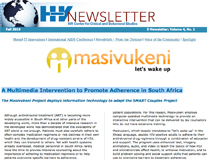
masivukeni_enews.jpg September 22, 2010. Masivukeni, the counselor support tool for delivering an HIV-treatment adherence intervention in clinics in South Africa, was recently featured in the Fall 2010 e-newsletter published by the HIV Center for Clinical and Behavioral Studies. The article, A Multimedia Intervention to Promote Adherence in South Africa, explains the research, development, and dissemination of Masivukeni, which is a joint project between CCNMTL and Dr. Robert Remien, a research scientist at the HIV Center for Clinical and Behavioral Studies and associate professor of clinical psychology.

Masivukeni is a CCNMTL Triangle Initiative project. Read A Multimedia Intervention to Promote Adherence in South Africa or learn more about Masivukeni.

Mendeley Blog Spotlights Global Honors College

mendeley_ghc.jpg August 10, 2010. Mendeley, the research management tool that allows users to index and organize PDF documents and research papers into your own personal digital bibliography, recently featured CCNMTL's Ashlinn Quinn in the Mendeley Blog. In the blog post, Ashlinn shares how Mendeley is used in the Global Honors College.. Read an excerpt below:

Throughout the Global Seminar, students are tasked with finding, reading, and annotating references in peer-reviewed literature that pertain to specific matters covered in the course. In the unit on Terrestrial Biodiversity, for instance, students searched the Web of Science for academic studies having to do with terrestrial species assessment, ecosystem services, and threats to biodiversity from climate change. Each student submitted references to the shared collection on Mendeley, using the “Notes” feature to annotate the references, and “Tags” to track who had submitted which references and to sort them by topic and by assignment.

After just six weeks of activity in the Seminar, the students have already collected almost 300 articles having to do with topics covered in the class, with new references being added to the collection every day. As the Seminar progresses, the students will refer to this library for group projects and research papers.

Visit the Mendeley Blog to read the full blog post.

The Chronicle of Higher Education Highlights Vietnam Collection

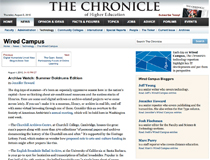
pv_chronicle.jpg August 5, 2010. The Vietnam Collection, an online archive of the 1983 WGBH series, "Vietnam: A Television History," which is currently being used in Columbia classrooms under Project Vietnam, was featured in the Chronicle of Higher Education. In Archive Watch: Summer Doldrums Edition, author Jennifer Howard lists the collection as one of the cool digital archives that she came across lately.

The Vietnam Collection is housed in WGBH's Open Vault archive, and comprises original footage and stills from the 13-hour television series. CCNMTL, along with the University of Massachusetts at Boston, partnered with WGBH Media Library and Archives to make the online collection available to the public and accessible for educators to use in the classroom.

At Columbia, the CCNMTL-developed Project Vietnam enables students to discover and watch full-length interviews and a range of stock footage from the Vietnam Collection; annotate, edit, and create sub-collections of these videos; and incorporate clips into multimedia projects. Faculty from Columbia University's Teachers College, Department of History, and Department of East Asian Languages and Cultures are integrating Project Vietnam into their curricula.

Visit the Vietnam Collection and learn more about Project Vietnam at Columbia.

New York Law Journal Features New Collateral Consequences Calculator

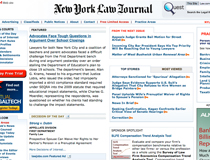
nylawjournal.jpg May 14, 2010. Collateral Consequences Calculator, the recently released web-based legal tool developed by CCNMTL and Columbia Law School, was featured on the front page of the New York Law Journal today. The article describes the Calculator, which is designed to provide an online overview of the complex collateral consequences associated with sections of the New York State Penal Law, and shares why Conrad Johnson, clinical professor of law and CCNMTL faculty partner, believes the tool will largely benefit the New York legal community: "There's simply too much to know, no one can accurately assess the consequences of a conviction in their head." Subscribers to the New York Law Journal can read the full article here.

Pierce Mattie Firm Interviews CCNMTL

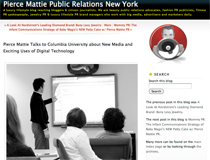
piercemattie.jpg May 10, 2010. Pierce Mattie, the New York-based lifestyle public relations firm, recently interviewed CCNMTL Web Designer Marc Raymond about a few Center projects and initiatives including Tobacco Cessation, Worth, and Project Rebirth.

Read the full interview, Pierce Mattie Talks to Columbia University about New Media and Exciting Uses of Digital Technology.

The Vietnam Collection Featured in New York Times

nytimes_vietnam.jpg May 3, 2010. The New York Times' Arts Briefly section recently featured the launch of the Vietnam Collection, the online video library developed and disseminated by a partnership between the WGBH Media Library and Archives, the University of Massachusetts in Boston, and CCNMTL.

The article, Rare Interviews Tell Vietnam’s Story Online, describes the Vietnam Collection's robust digital repository containing previously unavailable original interviews and stock footage from WGBH’s 1983 landmark series, Vietnam: A Television History. With a grant from the Institute of Museum and Library Services, CCNMTL joined WGBH and the University of Massachusetts in Boston to make the collection available to the public on WGBH's OpenVault website and used for educational purposes at Columbia University and other interested institutions.

Read the New York Times article here and learn more about the Vietnam Collection and Project Vietnam.

Opencast Community Profiles CCNMTL

opencast_ccnmtl.jpg May 3, 2010. The Opencast Community —a consortium of higher education institutions working together to explore, define, and document podcasting and course capture best practices and technologies—featured CCNMTL in an article detailing the Center's participation in community efforts related to the Opencast Matterhorn Project, an open source media system for managing and delivering educational audio and video content on the Web that is expected to launch this summer.

The article highlights CCNMTL's Digital Media Technologist Brian O’Hagan for his contributions in the Opencast Community, including planning meetings and working groups, and notes how CCNMTL plans to deploy Matterhorn at Columbia University: "CCNMTL hopes to implement the services of Matterhorn, namely publishing, encoding, and workflow, so that all media assets can be managed in an integrated manner as a part of the Center’s core [course] services. Once Matterhorn services are implemented as a core platform, Brian expects that CCNMTL will begin development on projects that extend Matterhorn functionality, quite likely including integration of their annotation tools."

Read the full article.

Downtown Express Features Project Rebirth and Partners
downtownexp.jpg April 13, 2010. In a recent Downtown Express article, author Julie Shapiro examines how the soon-to-be released Project Rebirth documentary is impacting teaching and learning at Columbia University and Georgetown University.

The article, Learning from the Healing Documented in 9/11 Interviews, depicts filmmaker Jim Whitaker’s quest to chronicle the recovery of nine people affected by 9/11 and the rebuilding of the World Trade Center. For seven years, Whitaker collected hundreds of hours of interview footage of the nine subjects as well as time-lapse photography from the World Trade Center site, leaving him with an abundance of film for the feature length Project Rebirth documentary. In an effort to build upon the educational significance of the documentary, the nonprofit Project Rebirth organization partnered with CCNMTL and the Center for New Designs in Learning and Scholarship (CNDLS) at Georgetown University to make the original, uncut footage available to professors, students, and clinicians.

Throughout the article, Shapiro describes Project Rebirth's educational initiative and sheds light on the various ways that professors at Columbia and Georgetown are using Project Rebirth in their classrooms: “Psychiatrists can study symptoms of grief and the success of the survivors’ coping mechanisms. Linguists can study the way men and women communicate differently about trauma. Anthropologists can analyze the subjects’ cultural background and how that affected their response and healing.”

The article also highlights plans for a new website for the Project Rebirth Center – an online resource for first responders, grief professionals, victims, educators, and students, featuring a wide range of resources including interview footage from the film and spaces for connecting individuals and organizations. In reference to the planned center, CCNMTL Executive Director Frank Moretti said, “[We want to] develop methods that would make it easier to respond to massive traumatic events, whether that’s 9/11, or the tsunami, or Haiti.” CNDLS Executive Director Randy Bass also shared his thoughts on how the center can benefit victims, survivors, and bystanders noting, “We run to the Web for solace, for information for other people with similar stories.”

Read the full article and learn more about the Project Rebirth Educational Initiative at CCNMTL.

CCNMTL Featured in Columbia Spectator Magazine

eye_ccnmtl.jpg March 5, 2010. A range of CCNMTL projects were recently featured in The Eye, Columbia Spectator's weekly features and arts magazine. In The Mouse Race, author Daniel D'addario expounds upon the technological happenings of the University Senate IT committee and CCNMTL. Educational technologist Michael Preston was interviewed for the article and shared a number of insights on services and projects underway at CCNMTL, including Engaging Digital Tibet, Video Interactions for Teaching and Learning, Mapping the African American Past, and the Millennium Village Simulation. Read the full article here.

The Record Publishes Article on Country X

countryx_news.jpgFebruary 22, 2010. A CCNMTL project developed with the Center for International Conflict Resolution (CICR) is the focus of a recent Record article. In Web-based Training Aims to Help Prevent Genocide, author Donna Cornachino explains the objectives and implementation of Country X, a project released in 2009.

Country X is a web-based educational simulation created in response to challenges surrounding the training and education of prospective genocide prevention practitioners. The simulation, developed in partnership with Professor Aldo Civico and deployed by CICR program coordinator Mark Whitlock, takes place in a fictitious nation experiencing rapid instability called Country X. Students in the course "Prevention of Mass Killing" work in groups with each student assuming the identity of one of four characters representing the perspectives of diplomatic, intelligence, military, and civil society communities. After analyzing a starting condition, players must address the situation from within their role by independently making a strategic policy decision and providing a rationale for it.

In the article, CCNMTL educational technologist Tucker Harding shares one of the overarching goals of the project: “In a course that has a word like ‘preventing’ in it, there’s a need to empower students to do something, not just know something. As part of a growing theme at Columbia to move certain courses from theory to practice, CCNMTL and our faculty partners are finding ways to bridge that gap.” Read the full story here.

Educational Technology Magazine Features VITAL

VITAL Video Viewer January 20, 2010. An article entitled "Examining Student Thinking Through Video Analysis" by CCNMTL educational technologist Michael Preston appears in the latest issue of Educational Technology Magazine (Vol. 50, No. 1, January-February 2010), which is a special issue on video analysis in teacher education. In the article, Preston discusses how preservice early childhood teachers engage with VITAL, the web-based video analysis system developed by CCNMTL and Prof. Herbert Ginsburg of Teachers College.

From the introduction to the article:

For preservice teachers, videos of children interacting with other children or with teachers can serve as more than a repository of "virtual kids." An inquiry-based approach to watching such video, supported by tools that allow for frequent and close viewing, provides an opportunity for prospective teachers to develop their skills of observation and interpretation before entering the classroom. Furthermore, the in-depth study of videos - particularly if the videos capture situations that reveal something about children's thinking - creates a context in which teachers can act as researchers by gathering evidence, developing hypotheses, and coordinating this information as a guide for further inquiry and teaching. Over time, close and repeated viewing and analysis of video helps shift focus away from the teacher and to the child, and allows for a richer conception of the relationship between children's performance and understanding, to help better inform teaching.

Learn more about VITAL.

Columbia News Singles Out Multimedia Connect on World AIDS Day

connect.jpg December 2, 2009. Multimedia Connect, the web-based HIV intervention project co-developed by CCNMTL, was the focus of yesterday's Columbia News article, Professor Teams With New Media Center to Better Inform Couples About HIV.

Multimedia Connect is based on the proven couples-level intervention called Connect that was designed for heterosexual couples at risk for HIV/STIs and developed by the Social Intervention Group at the Columbia School of Social Work. Principal investigator Susan Witte and CCNMTL created the multimedia version of the intervention, complete with interactive games, videos, and other training materials, and are currently testing the intervention in a five-year study supported with funding from the National Institute for Mental Health (NIMH). The study will test the multimedia version of the intervention against the paper version at 80 community-based organizations to measure levels of adoption of the intervention in its multimedia form.

Both Witte and CCNMTL are featured in the Columbia News article, which explains Multimedia Connect and the implications of the current study: "If the study, now in its third year, finds that community-based organizations are more likely to use the Internet-based version of the program, it may become a prototype for the prevention and treatment of other health and human services-related issues." Read the full article here.

Open Culture Features Havel at Columbia

openculture.jpg December 1, 2009. Havel at Columbia, a multimedia resource developed by CCNMTL and the Columbia University Arts Initiative to support former Czech President Václav Havel’s seven-week residency at Columbia University in 2006, was recently highlighted in the Open Culture post, The Velvet Revolution Revisited: Havel at Columbia.

The Havel at Columbia site contains a wide range of teaching and learning materials for classroom study of Havel’s life and art. The site features video interviews with scholars, artists, and political figures contributing their insights on Havel’s legacy as an artist and political leader, including Dean Lisa Anderson from the School of International and Public Affairs, former President George H. W. Bush, Edward Albee, Milos Forman, Lou Reed, and George Soros. Havel at Columbia also provides a timeline of events, an image glossary with photographs and primary documents, and archival footage from television and films, providing historical context for the Velvet Revolution and Havel’s presidency.

Open Culture, a website dedicated to exploring cultural and educational media freely available on the web, provides links to several Havel at Columbia resources and, in reference to the site's robust video library, noted, "Collectively, these conversations give you a very good feel for the man, the artist, and his historical contributions." Visit Open Culture to read the full post.

TC Today Profiles Executive Director Frank Moretti

compiled3.jpgNovember 23, 2009. Named a "worldwide force in digital education," CCNMTL Executive Director Frank Moretti is at the center of the recent TC Today article, "Saying Yes to Technology." The article profiles Moretti's accomplishments borne out of the Columbia Center for New Media Teaching and Learning, which he founded with Maurice Matiz in 1999. Several CCNMTL projects and their educational objectives are highlighted throughout the article—including the Global Classroom, Masivukeni, and VITAL —and the reader comes to understand how Moretti, a former Greek, Latin, and philosophy teacher with a doctorate in history from Teachers College, dreamed up an organization that today supports over 3,000 individual faculty members in the purposeful use of technology. "We looked at what was going on around us with computers, and we said, Jeez, we're living in another great revolution," said Moretti. To learn more, read Saying Yes to Technology.

CCNMTL Faculty Partner Joan Ferrante Receives Grant to Enhance Epistolae

November 9, 2009. Joan Ferrante, Columbia professor of English and comparative literature at Columbia University, has received a $40,000 grant to build on Epistolae, the online database created by Ferrante and CCNMTL that showcases a collection of letters to and from women during the 4th to 13th centuries. Ferrante was recently featured in The Record for receiving an Emeritus Fellowship from the Andrew W. Mellon Foundation to support the enhancement of Epistolae and continue her research on understanding the roles of women in medieval times, which she started over 20 years ago.

First released in 2000, Epistolae is a public website that offers scholars and students a repository of texts, translations, and background information about women engaged in correspondence in the Middle Ages. The letters, originally written in Latin, are translated to English and linked to biographical sketches of the women who wrote or received them.

According to the article, "Retirement for These Professors Means More Work," Ferrante will use the Emeritus Fellowship to hire translators for 2,000 letters waiting to be added to the online database.

Related links:
pdf link Download the article, "Retirement for These Professors Means More Work"